Quick answer — A real 3D figurine has volume: a profile, a back and depth. A photo printed on a PVC or acrylic plate is flat, cut around the silhouette and slotted into a stand. Before paying, ask for a side photo, the depth in millimetres and the exact material.
TLDR: "3D" sometimes describes the product image, not the object you receive. Nine checks settle it before you pay: side photo, depth, listing wording, real photos with scale, a rotatable 3D preview, a video in hand, customer photos, a named material, a coherent price. In practice it is simple: look closely at the photos, read the reviews and, above all, browse a gallery of real prints. Apply these checks to every seller, including us.
The problem: a cut-out photo sold as a figurine
Online, you will find "custom 3D figurine from your photo" offers where the item delivered is a photo printed on a sheet of PVC or acrylic, cut around the person's outline and slotted into a small stand. From the front, the difference is subtle. From the side, it is an edge a few millimetres thick.
Buyers find out when they open the parcel. And the disappointment does not stay with one order: it damages trust in the whole category.
Miniu, one of Europe's reference workshops for custom 3D figurines, prints full-colour resin figurines from customers' photos. Here are the checks we would run ourselves before buying from any seller, wherever they are based. Run them on us too.
The good news: it is easy to check
You do not need to be a 3D printing expert. Three habits are enough: look closely at the photos, read the reviews, and above all browse a gallery of real prints, photographed in the workshop and filmed in hand.
Fortunately, Miniu provides all three:
- Photos: the custom figurine page shows real photos and videos of printed figurines, not renders.
- Reviews: they are collected on the customer reviews page.
- A gallery of real prints: the gallery holds close to a hundred photos and around forty videos of real orders, and the size guide compares printed figurines side by side. The pages are in French; the photos speak for themselves.
The nine checks below detail what to look for, with us and anywhere else.
An acrylic standee is not a bad product
To be fair: the acrylic standee, also sold as an acrylic stand or photo cut-out, is a legitimate object: light, quick to produce and faithful to the photo, because it is the photo. As a wedding place card or a desk keepsake, it does the job well.
The problem is not the product; it is the label. A standee sold as a standee is fine. A standee sold as a "3D figurine" promises a volume it does not have, even when every word of the listing is technically defensible.
Where the confusion comes from
Three things combine, with no outright lie.
- "3D" can describe the image, not the object. A "3D effect" or "3D-style" visual describes the printed picture; the object can stay flat.
- Product photos are sometimes renders. A render proves that a file exists, not that anything was manufactured.
- From the front, plate and figurine look alike. That is the angle most listings use. The profile does not lie.
Flat printed plate vs 3D-printed figurine
| Check | Photo on PVC or acrylic plate | 3D-printed figurine |
|---|---|---|
| Volume | Flat: an edge a few millimetres thick | Full volume: front, profile, back |
| Dimensions listed | Height, width and plate thickness | Height, with real depth |
| Side view | A line | A complete silhouette |
| Back | Plain, transparent or a mirrored image | Modelled hair, clothing and back |
| How it is made | Flat print, often UV, then cut out | 3D modelling, then printing in volume |
| What you approve first | A flat image | A 3D preview you can rotate |
| Honest use | Display stand, place card, keepsake | Shelf figurine, lasting gift |
Nine checks to run before you pay
1. Ask for a side photo
The most decisive check takes one line: "Could you send me a side photo of a real order?" A figurine shows a nose, shoulders and a back; a plate, a line. If the seller sidesteps, you have your answer.
2. Look for the third dimension
A listing that only gives height and width describes a surface. A figurine has depth that varies with the pose. A thickness in millimetres that is identical for every design is a plate's.
3. Read the listing with the right words in mind
None of these words lies. Under a "3D figurine" title, they almost always describe a plate.
| Word on the listing | What it usually means |
|---|---|
| Plate, PVC, acrylic, plexiglass, Perspex | The flat sheet the photo is printed on |
| Standee, acrylic stand, photo cut-out | A flat silhouette slotted into a stand |
| "3D effect", "3D look", "3D style" | How the image looks, not the object's volume |
| UV printed | A flat print on the surface of the sheet |
| "Stand included", "removable base" | The slot or foot that holds the plate upright |
| Full-colour resin, printed in volume | An object genuinely made in three dimensions |
4. Tell a render from a real photo
A render gives itself away with a perfect background, flawless lighting and nothing to show scale. A real workshop photo shows a familiar object in the frame: a pen, a hand, a coin. If in doubt, ask: "Manufactured object, or render?"
5. Insist on a 3D preview you can rotate
A real figurine starts from a 3D model, which exists before printing and can be shown to you from every angle. If the only "preview" is a still, front-facing image, ask why.
6. Ask for a video in hand
A few seconds of the object turned between someone's fingers settles volume and scale at once. A plate does not survive this test.
7. Read reviews with photos, and look at the side
Customer photos taken at home say more than the seller's visuals. Look for one taken at an angle. If every one is strictly front-on, take note.
8. Insist on a named material
"Premium material" means nothing. "Full-colour resin tinted in the mass", "printed PVC", "UV-printed acrylic": those are answers you can check. Also ask whether the colour is in the material or on the surface.
9. Check that the price makes sense
A made-to-measure figurine requires modelling and printing in volume. Price alone settles nothing, but it points to the right question. For reference, a Miniu figurine starts from €41. Faced with a "3D" offer far below that, do not jump to conclusions: ask for the side photo.
What we show, and how you can check it
Here is what you can check at Miniu without taking our word for it.
- A public gallery of real prints. The gallery holds close to a hundred photos and around forty videos of real orders, photographed in the workshop. The captions are in French; the photos speak for themselves.
- "Generated → Printed" comparisons. For recent print batches, the render the customer approved sits next to the printed object. Differences stay visible.
- A scale reference. Photos include a pen in the frame, and videos show figurines held in hand.
- A preview to approve. A digital 3D preview is shown before printing: nothing goes into production without your approval.
- A named material. Full-colour resin tinted in the mass, around 10 million colours, 0.5 mm precision, matte finish. No filament printing and no hand-applied colour: there is no surface coat, so nothing chips.
- Reviews you can read. They are collected on the customer reviews page.
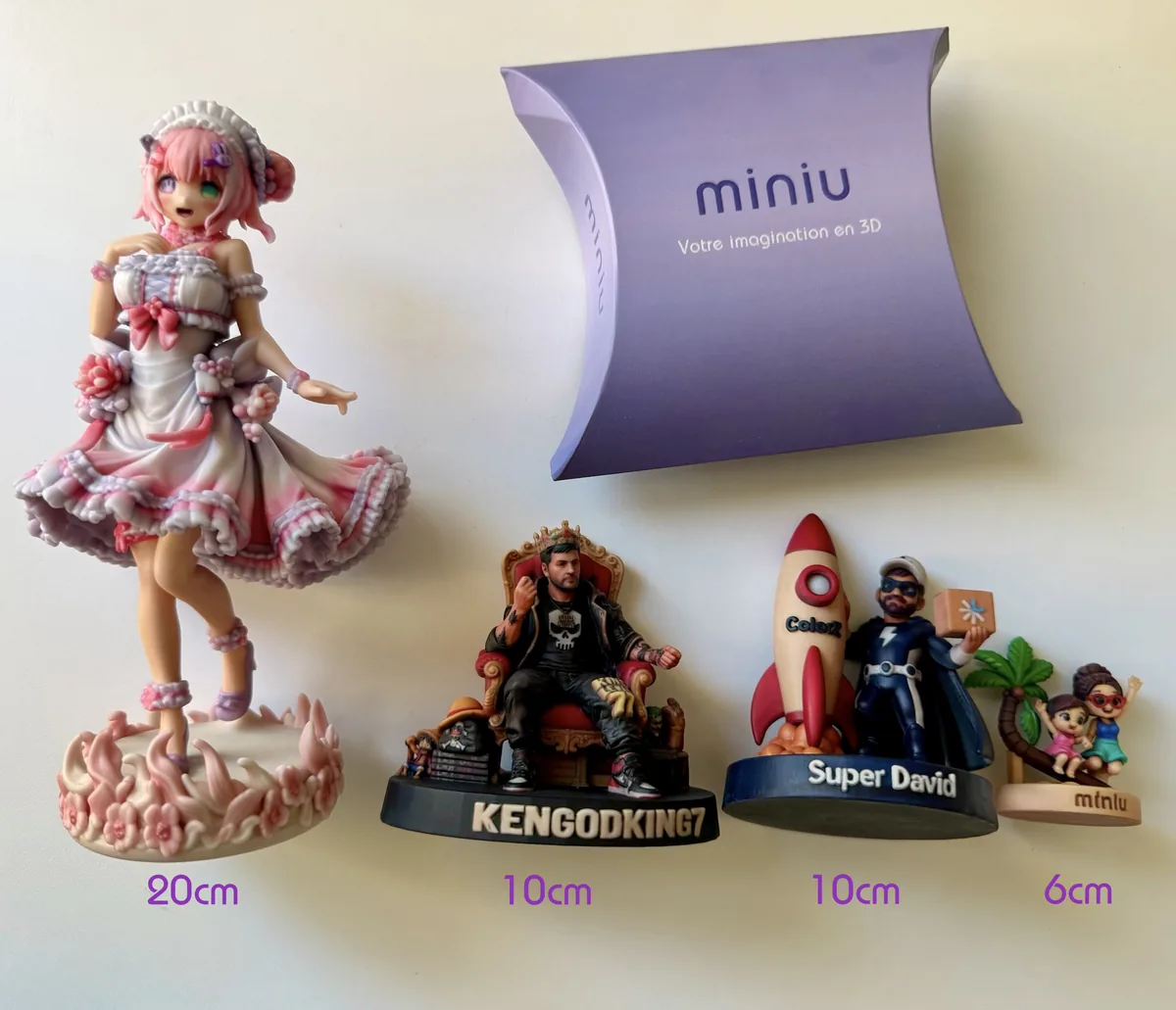
The photo illustrating this article is a workshop photo, not a render: a 20 cm anime character, two 10 cm figurines on engraved bases and a 6 cm cute figurine, next to a Miniu box for scale. In doubt? Ask us for a side photo of a comparable order, as this guide advises elsewhere.
What prints well, and what does not
More than 15,000 figurine projects generated from customers' photos since July 2025 have taught us one thing: a real 3D figurine has physical limits, and an honest seller tells you about them.
- Realistic style: a bust, or a full body at 8 cm minimum. For realistic figurines, 12 to 15 cm is recommended.
- Realistic full body at 6 cm: details become blurred.
- Small budget: the cute or chibi style enlarges the head, so the face stays readable. 8 cm is advised.
- 4 cm: not recommended, even in chibi style.
- If unsure: a 10 cm realistic bust.
- Fine details: elements thinner than 0.8 mm are fragile.
- Large formats: above 15 cm in the realistic style, on quotation, up to 50 cm.
Details are on our size guide (in French); for the starting photo, see the photo guide.
A useful paradox: a plate has none of these limits, because it is a photo. A "3D figurine" seller who never advises against anything should make you curious.
Ordering from outside France
Most of Miniu's pages are in French, but ordering is not a barrier: the figurine generator works in English at miniu.fr/?locale=en, and the French team is bilingual. Write to contact@miniu.fr in English and you will get an answer in English.
| Destination | Shipping | Free from |
|---|---|---|
| France | €8.99 | €120 |
| Belgium, Luxembourg | €12.99 | €120 |
| Switzerland | €16.99 | €150 |
For Switzerland, import VAT and the clearance fee are paid by the recipient on delivery. Canada is also served, and Miniu is present in Thailand through miniu.in.th. Count about 4 to 5 weeks for a single figurine, production and delivery included. Companies and larger quantities go through volume orders, with no limit on the type of project.
Mistakes to avoid
- Trusting the word "3D" in the title. It may describe the image, not the object.
- Mistaking a render for a photo of an object. Without a scale reference, nothing proves the object exists.
- Ordering without a preview to approve. You will discover the likeness when you open the box.
- Choosing a realistic full body at 4 or 6 cm to save money. Pick a bust or the cute style instead.
- Ignoring lead time and customs. A figurine that is genuinely modelled and printed takes weeks, and deliveries to Switzerland carry import charges on arrival.
Checklist before you pay
- Side photo of a real order received
- Depth of the object known, not just height and width
- Listing checked: no "plate", "acrylic" or "3D effect" under a "3D figurine" title
- At least one real photo with an object for scale
- Rotatable 3D preview offered before printing
- Video in hand or customer photos taken at an angle checked
- Material named precisely, colour in the material or on the surface
- Size consistent with style: realistic 8 cm minimum, 12 to 15 cm recommended
- Lead time and any import charges compatible with the gift date
FAQ: real 3D figurine or photo on a plastic plate
How can I tell whether a custom figurine is really 3D? Ask for a side photo of a real order. From the side, a 3D-printed figurine shows a nose, shoulders and a back; a plate shows an edge a few millimetres wide. Also ask for the depth of the object, the exact material and a 3D preview you can rotate before printing.
Is an acrylic standee a scam? No, not in itself. An acrylic standee is a legitimate product, useful as a place card or a keepsake. The problem starts when it is sold as a "3D figurine": it then promises a volume it does not have. A standee sold as a standee is perfectly fine.
What does "3D effect" mean on a product page? Usually that the printed image looks three-dimensional: shading, gradients, a 3D illustration style. The object itself can be completely flat. If a listing mentions a 3D effect, UV printing or acrylic, ask for a side photo before you order.
Why are product photos not enough? Because they are usually taken from the front, where a plate and a figurine look alike, and some are digital renders. Look for photos with an object for scale, such as a pen or a hand, videos of the item held in hand, and customer photos taken at an angle.
Can I see my figurine before it is printed? At Miniu, yes: a digital 3D preview is shown to you and must be approved before anything is printed. It is also a good test elsewhere: a real figurine starts from a 3D model, which exists before printing and can be shown to you.
What size keeps a realistic figurine detailed? In the realistic style, a bust or a full body at 8 cm minimum; 12 to 15 cm is recommended. At 6 cm, a realistic full body loses its detail. On a small budget, the cute style keeps the face readable, at 8 cm. 4 cm is not recommended. If unsure, pick a 10 cm realistic bust.
Check for yourself
Miniu, one of Europe's reference workshops for custom 3D figurines, publishes its real prints for a simple reason: proof beats a render. Browse the gallery, read the customer reviews, then start from a photo in the English version of the generator. Modelling is done in France by 3D artists, with an optional human retouch, Expert Touch, and the 3D preview awaits your approval before anything is printed. Questions in English are welcome at contact@miniu.fr.